The question
I went into this study believing that starting a campaign earlier leads to a bigger opening.
Trailer Math already records when every studio trailer lands. So I paired those lead times with opening weekends to see whether an early start pays off.
How I set it up
A raw comparison would mislead, because the films that start earliest are also the biggest: tentpoles with large budgets and existing fans. So I compared like with like.
- One genre: science fiction, US releases from January 2024 to October 2026. Starting in 2024 leaves out the pandemic years, when theaters were closed and many films opened on streaming the same day.
- Three types of film: franchise (sequels, reboots and spin-offs, all marketed to an existing fanbase), adaptation (books and remakes, with a smaller built-in audience), and original.
- Wide releases with a reported budget: films that reached 600 or more theaters. Seven smaller films were dropped and kept on record.
- Opening weekend, not lifetime gross: the opening is what a campaign is judged on. After it, reviews and word of mouth take over.
I collected each opening, theater count and budget by hand from The Numbers and Saturation.io, with a source for every figure.
What I found
Each group split in half by lead time, with typical (median) values:
| Group | Earliest-starting half | Latest-starting half |
|---|---|---|
| All 22 films | $80.5M opening · $190M budget | $4.0M opening · $50M budget |
| Franchise (9) | $70.5M opening · $205M budget | $90.6M opening · $203M budget |
| Original (8) | $12.5M opening · $98M budget | $3.4M opening · $18M budget |
| Adaptation (5) | $49.8M opening · $159M budget | $6.2M opening · $35M budget |
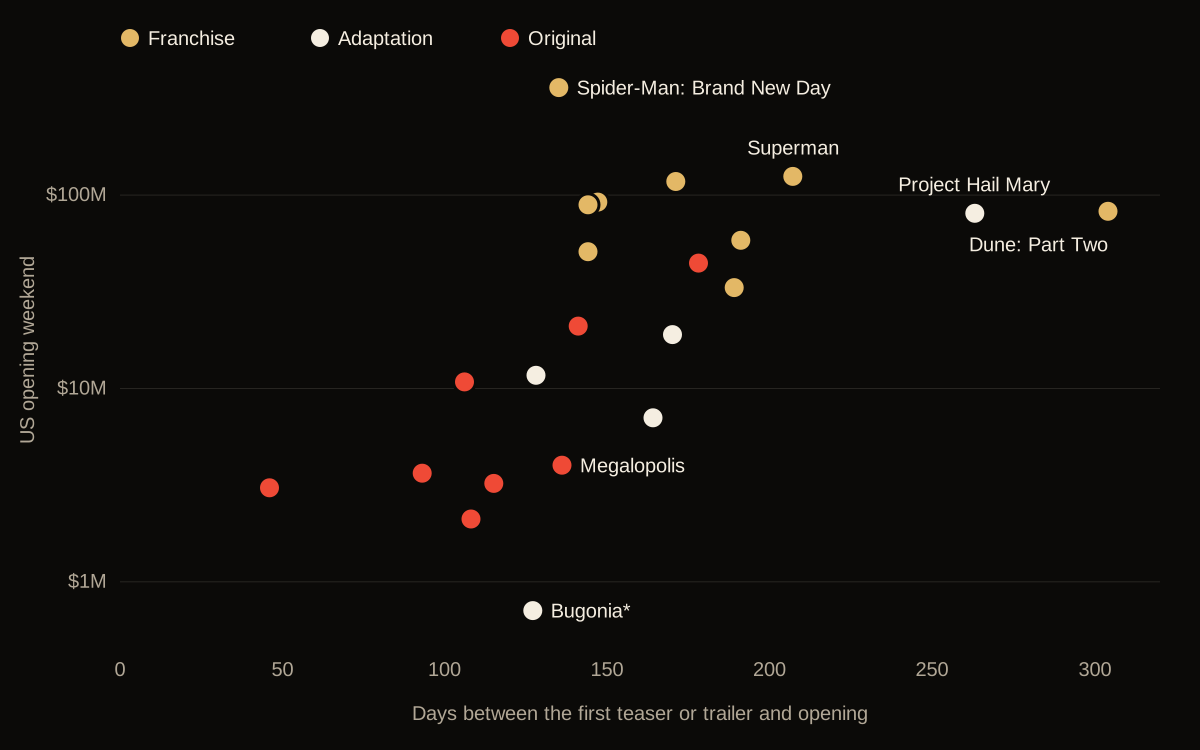
Across all 22 films, the early starters opened about 20 times bigger. But they also cost almost four times as much. Among franchise films, where budgets match, the early half opened smaller, and the latest-starting franchise film, Spider-Man: Brand New Day, had the biggest opening of the study.
Measured as opening weekend per dollar of budget, originals earned about the same whether they started early or late (0.17 against 0.18), and so did adaptations (0.28 against 0.30).
Why
Budget and brand drive both things at once. A studio starts a tentpole's campaign early because it can afford to, and the film opens big because it has a budget and a fanbase behind it. Compared across all films, lead time takes the credit for both.
Big-budget films start early because they can afford to. They aren't big because they started early.
What it means for a campaign
For a small or mid-budget film, copying a tentpole's long runway buys nothing in this data. Since audiences forget, the smarter bet is probably to save that money for a shorter, sharper push closer to opening. That last part is my judgment, not something this study measured.
Limits
- The groups are small, four to five films a side, so this shows no sign of an effect rather than proving there is none.
- One film moves the franchise result: Spider-Man: Brand New Day opened to $360M.
- Bugonia's opening weekend is a 17-theater platform launch, marked with an asterisk on the chart.
- Budgets are reported estimates, and Dune: Part Two's 304-day lead includes the 2023 strike delay.